Conflict Exit Strategy: The Physical Steps I Actually Take When a Fight Starts
by Kenya Ferguson | The Rebuilding of Self

Watch this episode
Episode 6 was about the words — the single statement that ends my participation without requiring anyone’s agreement first. Episode 7 is about what happens after the words: the body. Because a line only works if I can actually leave the room, and leaving the room only works if I have already decided how.
For a long time I treated “I need a break” like a feeling. I would say it, then stand there half-turned toward the door, waiting to see if he accepted it, waiting to see if the temperature dropped, waiting until the waiting itself became another fight. A time-out that never becomes physical is just a wish with better branding.
This post is the companion to Episode 7 of The Rebuilding of Self. It is the checklist I use when my heart rate spikes and the conversation starts to tilt — not a theory of conflict, a sequence of moves I can do with shaky hands.
If you have ever said you needed space and then stayed in the doorway arguing about whether you were allowed to take it, this one is for you.
Why the Body Has to Go First
Flooding is not a mood. It is physiology — heat in the face, tunnel vision, the urge to either win or disappear. Once I am there, clever scripts get thinner. My mouth still works, but my judgment does not. That is why the exit has to be physical before it is philosophical.
I used to try to “finish the thought” first. One more point. One more clarification. By the time I left, I had already said the thing I would spend three days regretting. The exit strategy is not about abandoning the issue. It is about refusing to negotiate while my nervous system is offline.
The single statement from Episode 6 opens the door. These steps walk me through it.
The Physical Steps I Actually Take
I keep this sequence short on purpose. Under stress I cannot run a twelve-step ritual. I can do five moves I have already practiced when I was calm.
One: I say the line out loud — my version of “I’m not doing this right now,” with a brief name for what “this” is — and I attach a return time. “I will come back at 7:40.” Specific. Not “later.” Not “when I’ve cooled off.” A clock time he can hold and I can keep.
Two: I put my feet on the floor and turn my whole body toward the exit. Not a half-turn. Not hovering. Orientation matters; the body believes what the posture does.
Three: shoes if I need them, keys if I am leaving the house, phone in my pocket so I am not hunting for it while he is still talking. I set these where I can grab them on ordinary days so I am not inventing logistics mid-fight.
Four: I leave the room. Hallway, porch, car, block walk — somewhere my ears are not still catching every word. If I stay within earshot, I am not out; I am staged.
Five: I do something boring and physical for the full window — walk, dishes, cold water on wrists, hand on chest, longer exhale than inhale. I do not draft rebuttals. Rehearsal is not regulation.
When the time hits, I come back. That last step is the one that separates a real time-out from stonewalling. If I cannot keep the return yet, I send one plain message with a new time. I do not ghost the clock I set.
What I Do Not Do on the Way Out
I do not slam the door for punctuation. I do not take a parting shot from the threshold. I do not stand in the doorway to “make sure he heard me.” Those are still the fight, just wearing an exit costume.
I also do not narrate every step as I take it. Over-explaining the exit recreates the over-explaining problem from Episode 6. The statement already carried the meaning. The body carries the boundary.
And I do not check my phone every thirty seconds to see if he is okay with my leaving. His comfort is not the metric. My regulation is.
Practicing When Nothing Is on Fire
I practiced the path when we were fine. Walked from the living room to the porch with a made-up return time. Put my shoes where my hand expects them. Said the line into an empty kitchen so my mouth knew the shape of it.
It felt ridiculous. It also meant that the first real night I needed it, I was not inventing choreography under adrenaline. Muscle memory is kinder than improvisation when you are flooded.
If you live with someone, you can name the protocol once, calmly, outside of conflict: “When I say I need twenty minutes and a time, I am leaving the room on purpose, and I will be back.” You are not asking permission. You are giving a map.
What This Looks Like Now
Fights still start. I still feel the heat climb. What is different is how fast I move from words to feet. Some nights the exit is clean. Some nights I still linger and have to restart the sequence halfway. I count the restarts as practice, not failure.
The open door is not abandonment. It is the difference between a pause with a return and a silence that swallows the whole evening. Episode 3 gave me the script. Episode 6 gave me the single statement. This episode is the body catching up to both.
What I Learned
A boundary you cannot physically enact is still an idea. The work was making the exit as boring and repeatable as brushing my teeth — shoes, statement, time, door, walk, return — so that when the room got loud, I had somewhere to put my hands and my feet besides the argument.
Reflection Questions
- When a fight starts, what does your body do before your mind has a sentence?
- Where do you usually freeze — doorway, couch, phone — instead of completing an exit?
- What would a specific return time sound like in your voice, said out loud once while calm?
- What boring physical reset actually helps you (walk, water, dishes), and what only looks like a break while you rehearse the fight?
Today’s Journal Prompt
Write the exact physical sequence you will use the next time a conversation floods you — room you leave, where shoes or keys live, one grounding action, and a sample return time. Then note what usually stops you from finishing that sequence.
Resources Mentioned
- —The Time-Out Protocol — Episode 3 of The Rebuilding of Self
- —The Art of the Single Statement — Episode 6 companion post
- —Atomic Habits by James Clear (for practicing the exit when nothing is on fire)
Products I Personally Recommend
My recommended journaling tools
- —My favorite notebook
- —My favorite pen
- —A simple kitchen timer or phone alarm for return times
- —Comfortable shoes I can grab without thinking
- —The book I referenced above
Closing Thoughts
I used to think leaving the room meant I was weak or dramatic. Now I think staying past the point of regulation is what costs the most. The door is not the end of the conversation. It is how I stay someone I can still come back as.
One Small Step Today
Tonight, while things are calm, walk your exit once: say a practice return time out loud, touch your shoes or keys, step outside or into another room for two minutes, then walk back in on purpose. No fight required — just the path.
If this article resonated with you, consider subscribing on YouTube or sharing it with someone who might need to hear it.
Watch Next
Dealing with Deflection — Responding When They Pivot and Blame You
Watch on YouTube
See this episode on Just Kenya Being Kenya
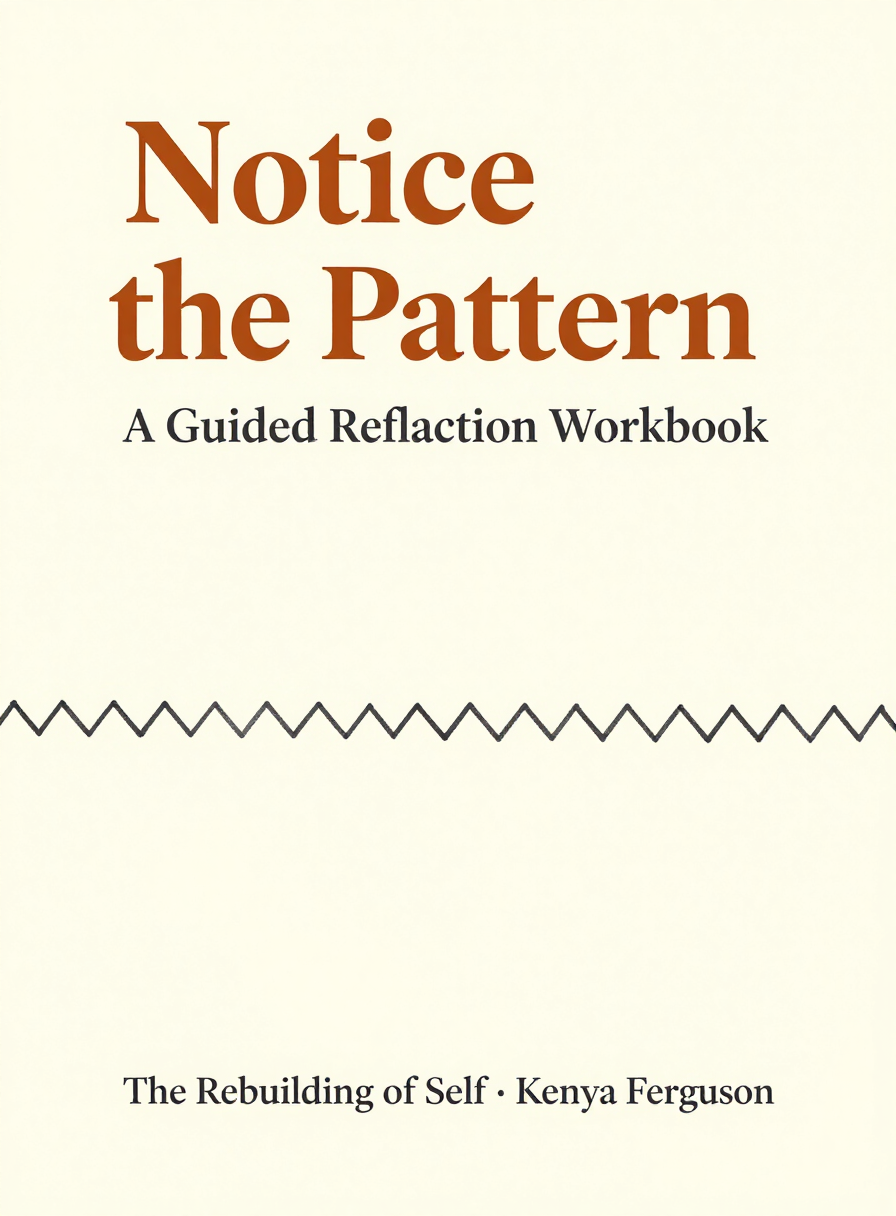
Free Workbook
Notice the Pattern: A Guided Reflection Workbook
Notice what keeps repeating, identify what you need, and choose one realistic next step.
Download the WorkbookKenya Ferguson is the creator of Just Kenya Being Kenya and the author of The Rebuilding of Self, a resource for adults navigating relationship challenges, personal recovery, and the daily work of finding their way back to themselves. The Rebuilding of Self is a publication of Sacred Heart Collective.
Related reading
Communication & Safety
The Time-Out Protocol: My Non-Negotiable Script for Conflict
Communication & Safety
The Art of the Single Statement: How I Learned to End Arguments Without Explaining Myself to Exhaustion
Betrayal Trauma & Individual Healing
Weaponized Silence: How I Stopped Letting the Anxiety Win When He Disappeared
Communication & Safety
The Stonewalling Cycle: Why I Had to Go First
Previous episode
The Art of the Single Statement: How I Learned to End Arguments Without Explaining Myself to Exhaustion
Next episode
Dealing with Deflection: What I Do When He Tries to Pivot and Blame Me Instead
Coming up
- When Accountability Is a Performance
- Trust as a Track Record, Not a Feeling
- The Boundary That Held
Want to know when the next one lands?