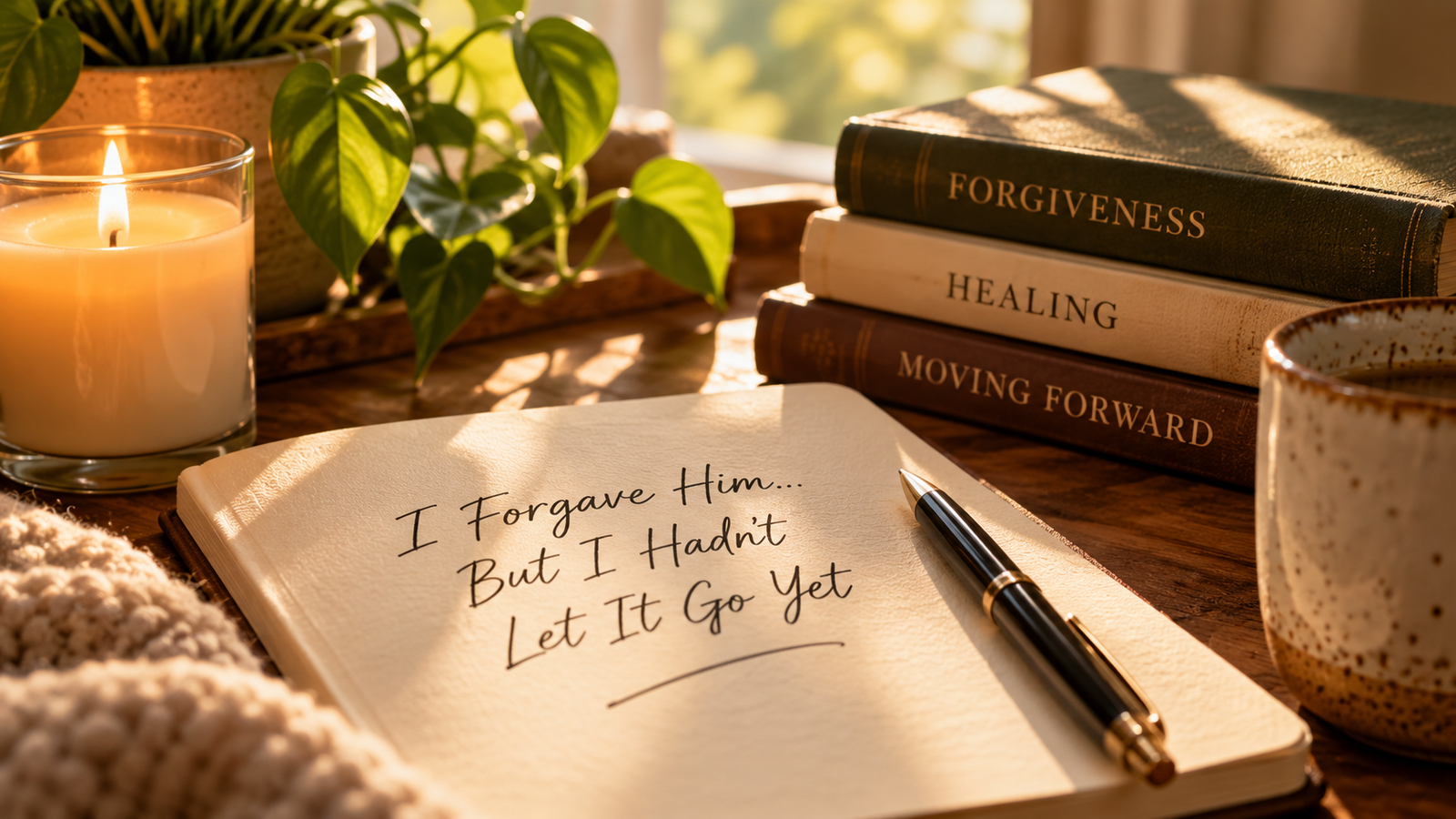
I Forgave Him — But I Hadn't Let It Go Yet
by Kenya Ferguson | The Rebuilding of Self
Watch this episode
There is a version of forgiveness that looks right from the outside and still quietly destroys you from the inside. You say the words. You mean them. You make the choice to stay, to rebuild, to try. And then six months later — or a year later — you're still pulling the past out in arguments like a card you've been saving. Still measuring every silence against what happened. Still carrying something you already said you put down.
That was me. For over a year after I forgave him, I was still using the betrayal as leverage. Not consciously. Not cruelly. But I was reaching for it every time I felt unsafe, every time something reminded me, every time I wanted to win.
And I kept asking myself the same question: Kenya. You forgave him. So why are you still doing this?
It took me a long time to understand the answer. Forgiveness and letting go are not the same thing.
What Forgiveness Actually Is — And What It Isn't
Forgiveness is the decision to release someone from the debt. It's a grace you extend — to them, yes, but mostly to yourself. It's the choice that says: I'm not going to let what you did define what comes next.
But forgiveness doesn't automatically rewire the nervous system. It doesn't dissolve the memories or stop the triggers. It doesn't mean the past stops showing up. It just means you've made a decision about how you're going to relate to it.
What I didn't understand — what I had to live my way into understanding — is that letting go is a separate act. And it comes after forgiveness, not with it.
The Gap Between Forgiving and Letting Go
I spent over a year in that gap. Forgiven, but not released. Committed to the relationship, but still collecting interest on a debt I said I had cancelled.
The triggers in that gap didn't always look dramatic. Sometimes it was something small — a text I sent that he didn't answer quickly enough. And I would feel it. That familiar tightening. That pull toward suspicion.
But I've learned to stop and ask myself: is my "fast enough" based on my feelings or on reality? Because he might be in the back fixing equipment. He might be in the middle of something I'm not aware of. The timeline I'm measuring him against isn't always the truth. Sometimes it's fear wearing a stopwatch.
My pastor has always said: you can't let the past be the ruin of your future. We're meant to learn from it — not be held hostage by it. I've carried those words with me for a long time. I understood them intellectually. But truly living them is something else entirely.
The Day I Said It Out Loud
The moment I finally let go wasn't dramatic. It was a realization — one I had probably circled a hundred times — that finally landed differently. I accepted that it was time. And then I said it out loud.
To myself first. Because hearing your own voice say something makes it real in a way that thinking it never does. I needed to hear myself say: I am choosing to let this go.
And then I told him. I explained exactly what letting go meant to me, because it needed a definition. It wasn't pretending it didn't happen. It wasn't forgetting — I told him plainly that I would never forget. What it meant was this: I was not going to bring it into arguments anymore. I was not going to use the past to win the present. I was going to base everything going forward on who we are right now.
The weight lifted immediately. I didn't expect that. I thought letting go would feel like loss. Instead it felt like I had finally put something down that I had been carrying so long I forgot I was holding it.
What Triggers Look Like Now
Triggers still come. Something he says or does will remind me of that time, and the feeling surfaces. But now it moves through instead of taking over.
Before, I would spiral. I would get so angry. I would chase him away and then be upset that he was gone. It was a cycle I couldn't seem to stop even though I could see it clearly.
Now, when something triggers me, I give myself space. I distance for a little while — not to punish him, just to let the feeling breathe. And when I'm ready, I go back to him. Sometimes I tell him what's bothering me directly. Sometimes I don't say anything at all and it passes. And sometimes — and this is the part that still surprises me — I just ask for a hug. And while he's holding me, I tell him what's going on.
That's how different things are now. That's what letting go made possible.
The Difference Between Then and Now
The most honest way I can describe the difference: before, a trigger was a door that opened onto the entire past. Now it's just a feeling that passes through.
I still have to make the choice in the moment. I still have to ask myself whether what I'm feeling is based in the present or the past. I still have to decide, again and again, to stay in the now.
But the choice is available to me in a way it wasn't before. Because I'm not carrying the weight anymore.
Forgiving someone is an act of grace. Letting go is an act of choice. And that choice has to be made out loud — to yourself, to them, to the version of you that's been holding on longer than she needed to.
We're not letting go because what happened didn't matter. We're letting go because our future matters more.
Reflection Questions
- Have you ever said you forgave someone while still reaching for the past in arguments?
- What does "letting go" mean to you — and how is it different from forgetting?
- When a trigger hits, do you treat it as proof that nothing has changed, or as a feeling that can move through?
- What would it sound like to say out loud that you are choosing to put the weight down?
Today’s Journal Prompt
Write about something you already decided to forgive — and name, honestly, whether you have also let it go. If there is still a gap, describe what you are still carrying and what it might look like to set one piece of it down out loud.
Resources Mentioned
- —Episode 3: The Time-Out Protocol: My Non-Negotiable Script for Conflict
- —Episode 5: Weaponized Silence: How I Stopped Letting the Anxiety Win When He Disappeared
- —Episode 6: The Art of the Single Statement: How I Learned to End Arguments Without Explaining Myself to Exhaustion
Products I Personally Recommend
My recommended journaling tools
- —My favorite notebook
- —My favorite pen
- —The microphone I record with
- —The desk light I use
Closing Thoughts
Forgiving someone is an act of grace. Letting go is an act of choice. We are not letting go because what happened did not matter. We are letting go because our future matters more.
One Small Step Today
If you are still holding something you already said you forgave, say one sentence out loud today — to yourself first: "I am choosing to let this go." You do not have to mean it perfectly. You only have to hear your own voice start the release.
If this article resonated with you, consider subscribing on YouTube or sharing it with someone who might need to hear it.
Watch Next
Weaponized Silence — How I Stopped Letting the Anxiety Win When He Disappeared
Watch on YouTube
See this episode on Just Kenya Being Kenya
Kenya Ferguson is the creator of Just Kenya Being Kenya and the author of The Rebuilding of Self, a resource for adults navigating relationship challenges, personal recovery, and the daily work of finding their way back to themselves. The Rebuilding of Self is a publication of Sacred Heart Collective.
Related reading
Communication & Safety
The Time-Out Protocol: My Non-Negotiable Script for Conflict
Betrayal Trauma & Individual Healing
Weaponized Silence: How I Stopped Letting the Anxiety Win When He Disappeared
Communication & Safety
The Art of the Single Statement: How I Learned to End Arguments Without Explaining Myself to Exhaustion
Betrayal Trauma & Individual Healing
Betrayal Triggers: 3 Tools for Managing Trauma Fallout
Previous episode
Setting Phone Boundaries: The Policy That Finally Made Sense for Us
Next episode
Stop Chasing Someone Who Has Gone Silent: Do This Instead
Coming up
- When Accountability Is a Performance
- Trust as a Track Record, Not a Feeling
- The Boundary That Held
Want to know when the next one lands?